
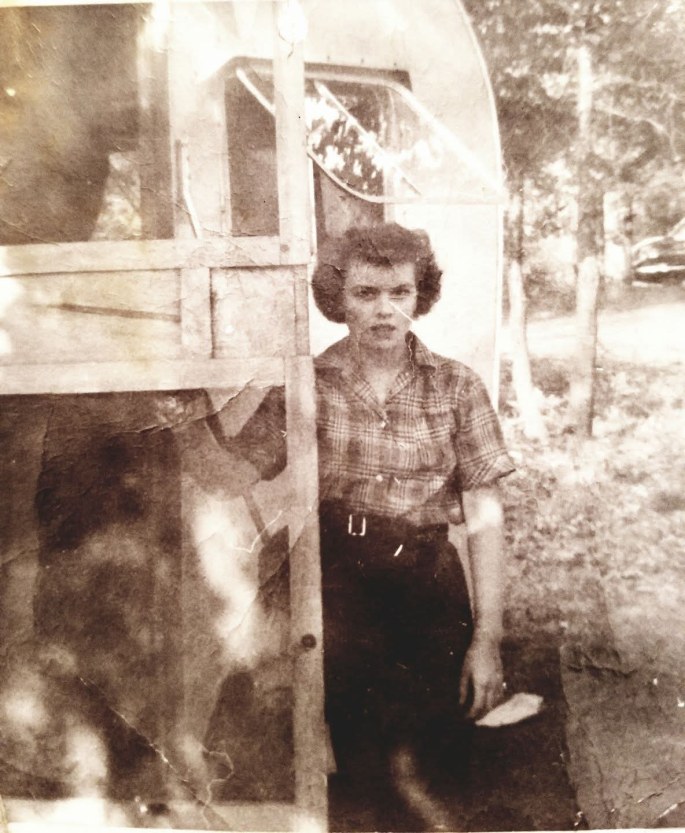
My mother once caught the biggest walleye anyone in our family and circle of friends had ever heard of.
The funny part?
She didn’t fish.
She couldn’t even swim.
Here’s what happened.
Around the time I was in third grade, my parents decided the only vacation they could afford was camping for free. By that time in my life, they shared their home with six children, eventually becoming eight. During the early sixties, trees and agricultural farms surrounded our five-acre Belmont, Michigan lot where we lived in a small ranch house. Farming was the chief occupation in the neighborhood, but newer settlers, like my father, commuted to Grand Rapids, where he worked as an electrical technician for Lear Siegler. Families were large, and just about everyone lived on a tight budget. Activities centered on church events, berry and mushroom gathering, swimming, hunting, fishing, and winter ice-skating and sledding, all of which cost nothing.
My mom and dad couldn’t afford a cabin or far-away travel, so after school ended in June, we’d close our house, pack all of our camping equipment in a utility trailer, and head for the Manistee National Forest near Hardy Dam in Michigan. My dad set up camp like a military operation. He was a U.S. Navy man and owned a military tent that had formerly been a barracks for servicemen.
The first year, all the children slept in the enormous tent in sleeping bags on the floor. After torrential early summer rain had us kids waking up soaking wet, he purchased wooden cots that kept us elevated and dry. My parents organized different areas: a gathering corner around our big picnic table, a cooking area with long wooden bookshelves that held our pantry items, tables for a Coleman propane stove and dish racks, and hanging hooks for fruit, potatoes, onions, and other non-perishable items. The wash area held a freshwater basin, towels clipped to a branch, and a big washtub with a clothesline strung behind it for the clothes washing my mom would do by hand. Our latrine, located away from camp, was a big pit with a board stretched across the hole and held up with two plastic buckets. Using the restroom could be a tricky business, as there was always a chance of falling in.
Because he intended to camp long-term (we usually stayed a couple of months), my dad did not rely on coolers for refrigeration. That was a practical choice, as the ice melted so fast. He instead dug a large pit, lined it with heavy plastic, then placed block ice on the bottom. Milk, eggs, meat, and other perishables stayed cold for nearly a week on only two blocks of ice. I can still remember how cold it felt when we had to grab one of the glass half-gallon bottles of milk. My dad replenished the ice twice a week when he purchased supplies on the way back to camp after work.
The siblings had fun hanging the hammock, sweeping the “floor” with white pine branches, and helping to make the camp tidy. It was like playing house, one of our favorite games, for about eight weeks. My mother always approved of that vacation in subsequent years. She didn’t have to keep up a house with six active children always making messes, and we were free to roam anywhere we wanted during that time. I remember her writing stories in a camp chair while we occupied ourselves building forts, going on nature hikes, and splashing in the water for hours on sunny days.
My mother had no way of communicating with the outside world when she was at camp, as our family only owned one car. We didn’t have a radio, nor electricity. Cell phones didn’t exist. There was no running water, so my dad would refill huge five-gallon containers of drinking and cooking water and bring them on his daily return. Music came from our own voices or my dad’s old acoustic guitar. The remaining forms of entertainment were playtime and storytelling at night.
Today, you would have to pay a lot of money to rent that spot. During the sixties, we could stay as long as we liked. The opening in the forest where we set up stood on a bluff, surrounded by pines and other deciduous woods, perfect for cooling a summer home. The Muskegon River was out front with a white sandy bank leading to crystal-clear water, offering the best swimming I’ve ever experienced.
My father could only spend a full week with us at the beginning. For the rest of the summer, he commuted to his job in Grand Rapids and joined us after work until the weekends. He enjoyed our “resort” as Mom never complained much at camp about his nightly beer habit. The vacation atmosphere lightened her stress and, now I realize, gave her the time she needed for creative expression.
Summer couldn’t stay perfect forever. There came a time when my mom grew tired of my father grabbing a six-pack of beer and heading to the boat right after work. He had been intent on catching the monster walleye that had been lurking out in front of our camp. It was at least twenty-eight inches long, and my dad estimated its weight at eight to nine pounds. The reason his estimate was accurate was that he once had it on his line, but the fish broke free. He caught many others, and we lived on what we brought from home, limited grocery items, and fried and smoked fish. Still, he yearned for the trophy.
My mom had grown tired of washing clothes by hand, and having the stress of cooking meals, doing dishes, and checking on six of her offspring, always heading for a little mischief whenever we could. She wanted just one quiet hour to herself. She couldn’t find relaxation in the water, fishing, or boating because she feared the water. Her mom never taught her to swim, and she had been afraid that if she waded out too far, she could lose her balance and drown.
I remember the day of the argument. It was then that the idyllic life came to a stop for her. My parents yelled back and forth, my dad claiming his fishing nights were keeping the family alive and my mother screaming she was tired of all the responsibility of the kids, two of which were still in diapers.
My mother stomped down the sandy bank as my dad ran after her, telling her to stop. She shot back, “I’ll just catch that damn fish. You wait and see.” She jumped into the boat and shoved off from the shore. He let her go, thinking that she would turn around. He always used oars to navigate the small aluminum boat, and he was certain she wouldn’t have the strength to gain any distance.
Barbara Jean shocked us all. She rowed quickly, without a life jacket, to the distant spot out front of our camp, anchored the boat, rigged up his pole, and cast her line into the water. Stunned, my dad returned to the main camp up the embankment. The kids stayed on the beach for a while. The younger siblings followed my dad and my older sister. Finally, I was the only child left on the beach, fearful that if I turned away, I would look out and see an empty boat, and know my mother had fallen overboard, never to come back to us.
The sun was almost setting, yet I still watched. I could see my mom’s hand raised in the air to cast the line, but couldn’t see anything else that was happening. I was surprised she even knew how to use Dad’s fishing pole and wondered if she had even caught a minnow. After what seemed like hours, I spotted her pulling on the oars and returning to shore. When she got close enough to yell, she screamed, “Go get your dad.”
I thought maybe she had cut herself, or snagged the line somewhere on her body. I jetted up the hill and the entire family ran back down to the water together. My mom didn’t say another word as she pulled the boat onto the sandy beach.
Then she reached into the boat and lifted the biggest fish I’d ever seen. We all cheered, even my dad. I expected Dad to be furious. Instead, he gave her a big hug and said, “Good job, Barb.”
I’m not sure if I ever saw a wider smile on my mother’s face. She had proven something to us and to herself.
Life has a way of taking us in all different directions, but even years later, my dad still proudly told his fishing buddies that his wife had caught the biggest walleye he’d ever seen.
Kathleen Lynn
Author
July 14, 2026
Campfire Prompt
Every family has a story that gets told around the dinner table, at reunions, or beside a campfire. Sometimes it’s funny. Sometimes it’s unbelievable. Sometimes it becomes part of the family’s history.
What story has been passed down in your family over the years?
There are no right or wrong answers. Pull up a chair and tell us your story.

